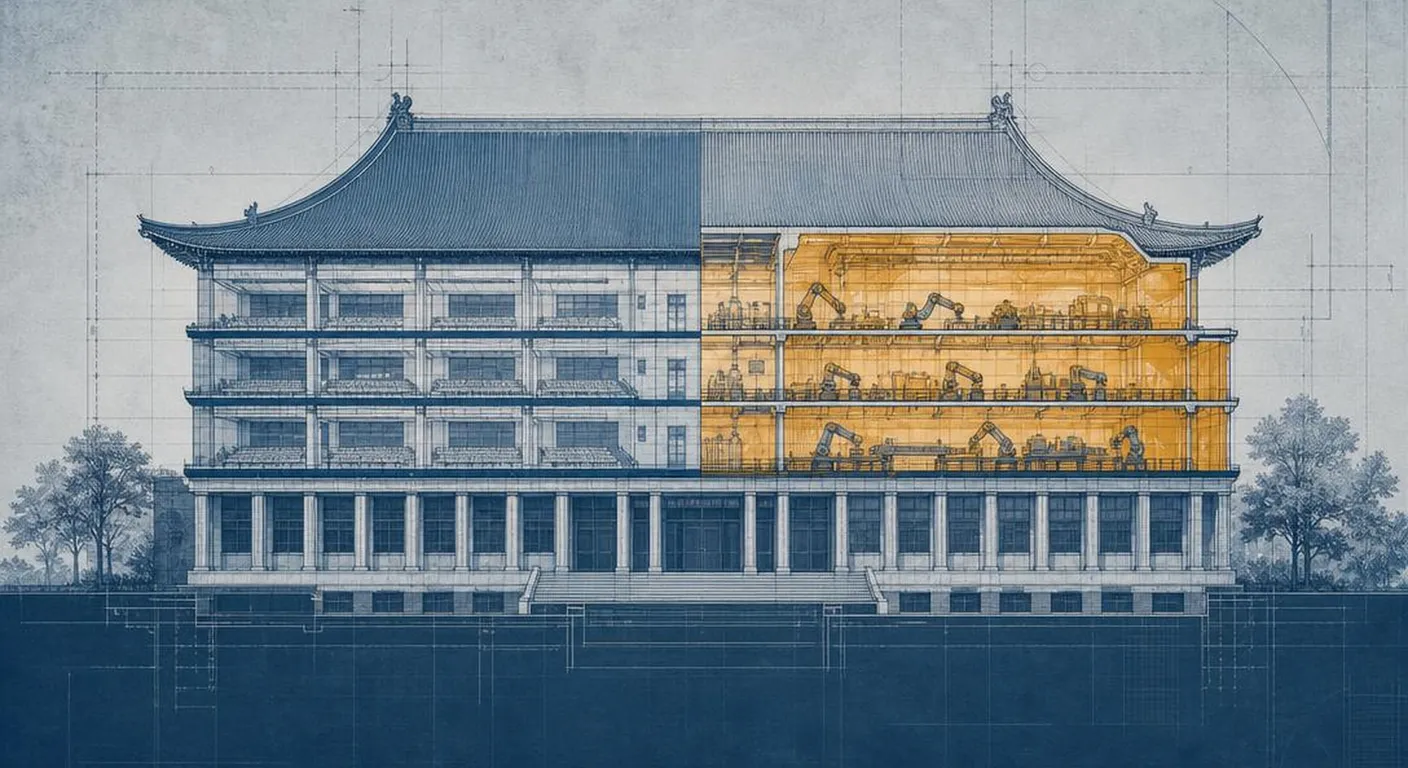
Between 2021 and 2025, China revoked or suspended 12,200 undergraduate degree programs and opened 10,200 new ones in their place. More than 30 percent of everything a Chinese student can study was redrawn in five years. The fields it cut were the arts, the humanities, foreign languages, and management. In their place came artificial intelligence, robotics, and semiconductors.
This was not a market correcting itself. It was a state deciding what a generation is allowed to learn.
The cuts followed the unemployment line
China's youth unemployment rate has stayed above 16 percent through early 2026, reaching 16.9 percent in March. Record numbers of graduates are leaving university into a job market that has little use for the degrees many of them hold. The ministry's answer was to stop producing those degrees. The fields it pulled down, arts, humanities, foreign languages, and management, are the ones it now treats as oversaturated.
This is the part that should give every education ministry pause. The supply of graduates was adjusted not by the students choosing differently, but by the state removing the option.
What replaced them reads like a procurement list
The 10,200 new programs cluster around the technologies Beijing has named its future industries: artificial intelligence, robotics, semiconductors, and a field China calls embodied intelligence, the science of machines that move and act in the physical world. For 2026, the Ministry of Education approved 38 new undergraduate majors, among them brain-computer science, agricultural robotics, and commercial AI. Nine universities, including the Harbin Institute of Technology and Beihang University, are opening embodied intelligence degrees this year.
Taken together, the new catalog looks less like a university course list and more like a staffing plan for a robotics economy.
A faster lever than the economy itself
Most governments facing a jobs mismatch try to grow the industries that need workers. China is doing the more direct thing: changing what the workers are trained for, by decree, at national scale. A degree program is a slow object. It takes years to build a department, hire faculty, and accredit a major. Redrawing a third of them in five years is not tuning at the edges. It is running higher education on the same clock as the 14th Five-Year Plan, which covered 2021 to 2025, the exact window of the overhaul.
Why it matters
There is a wager buried inside the plan, and it is not a comfortable one. China is training an army of AI engineers at the moment AI has begun to displace engineers. The bet assumes demand for the people who build these systems will outrun the systems' own ability to replace them. If the bet pays off, China graduates the workforce of the next economy a step ahead of everyone else. Get it wrong, and it has funneled a generation into fields that automate faster than they hire, with the humanities exits already closed behind them.
The quieter move is the one to watch. A country that can rewrite a third of its degrees in five years has decided that what a generation studies is too consequential to leave to the students. Talent is no longer allocated by the market. It is allocated by the plan. Every government with a graduate-jobs problem is now watching one experiment in real time, because if central planning can read the labor market better than millions of individual choices can, the case for letting education follow personal preference gets a very large and very fast counterexample.
A degree is a bet a teenager places on what the world will need in a decade. China has taken that bet out of the teenager's hands and made it itself, from this year's labor data. The question is whether a planner can guess a generation's future better than the generation can, and whether you would want to live in the country that turns out to be right.
Originally published as an Instagram carousel on @recul.ai.