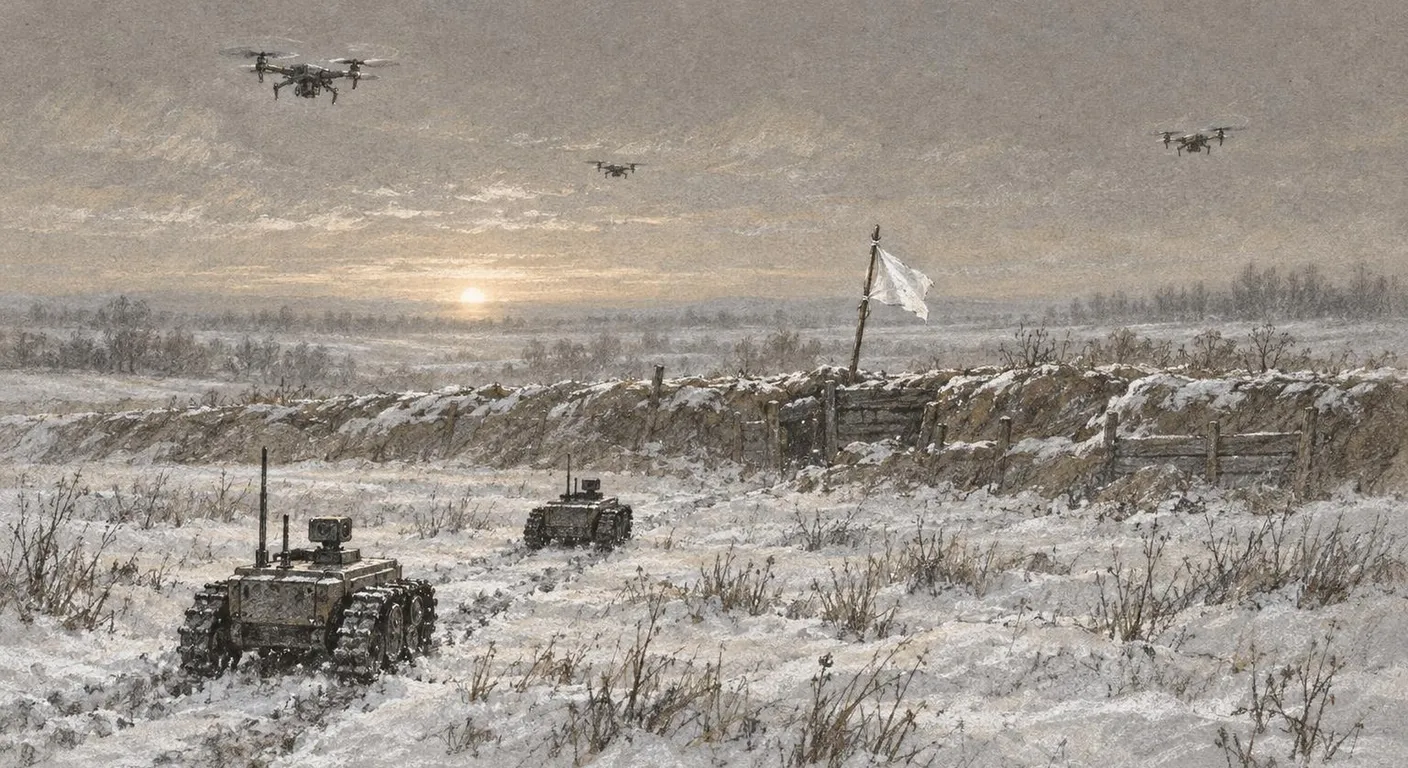
On April 13, 2026, Ukrainian forces seized a Russian-held position and no Ukrainian soldier set foot in the assault. Drones flew above. Ground robots rolled in. The Russian defenders surrendered to machines.
What happened
President Zelenskyy announced the operation during Ukraine's Arms Makers' Day, describing it in plain terms: "For the first time in the history of this war, an enemy position was taken exclusively by unmanned platforms — ground systems and drones. The occupiers surrendered, and the operation was carried out without infantry and without losses on our side."
The assault force had names. Ratel and TerMIT rolled on tracks. Ardal, Rys, Zmiy, Protector, and Volia handled reconnaissance, strike, and logistics across the operation. Some carried weapons. Some carried only sensors. Together, as Army Recognition reported, they performed a task that, under every previous version of this war's doctrine, would have cost human lives to complete.
This was not a stunt
The scale behind this single operation is what makes it legible as strategy rather than spectacle. In the three months prior to April 13, Ukrainian ground robotic systems completed more than 22,000 missions on the frontline. That is roughly 240 robotic missions per day. A military running at that tempo does not attempt a fully unmanned assault as a demonstration. It attempts one because the infrastructure, the coordination, and the operational confidence are already there.
This also was not the first time Ukraine had pushed in this direction. As The Debrief reported, Maj. Gen. Curtis Taylor, commander of the U.S. Army's 1st Armored Division, documented an earlier "all-robot assault" by Ukraine's 13th Khartiia Brigade in early December 2024, analyzed in the U.S. Army Military Review. That operation required infantry follow-up to hold the ground. April 2026 did not. The distinction matters: the gap between those two operations is the gap between testing a capability and operationalizing it.
The shift nobody wants to say out loud
The coverage of this operation has focused, understandably, on what it saves. Ukrainian soldiers did not die taking that position. That is real, and it matters. But there is a second-order effect that gets less attention because it is less comfortable.
For roughly a century, the political cost of land warfare has been its human cost. Governments answer to people who lose sons and daughters. That cost does not eliminate war, but it constrains it. It creates friction. It makes leaders hesitate before ordering an assault that will come back in body bags.
When the attacker risks hardware instead of people, that friction changes. Not disappears, but changes. Hardware can be replaced. Hardware does not have a family. The calculus on whether to order an attack is not the same when the downside is a destroyed robot rather than a dead soldier.
The Times noted that the Russian defenders surrendered not to a human presence but to machines: no translator, no negotiator, no face across the wire. A camera, the pressure of the platforms around them, and the understanding that more were coming. That is a new kind of psychological reality on a battlefield, and the doctrine written from it will spread.
Who is taking notes
The Telegraph framed this as a glimpse of future warfare. That framing is accurate but undersells the immediacy. Every military with the budget and the technical base to field ground robotics at scale is watching this operation. Not in a distant, theoretical sense. In a "what do we need to procure and how fast" sense.
Ukraine developed this capability under live-fire conditions, with urgent necessity and a domestic defense industry incentivized to iterate fast. Other militaries will attempt to compress that learning curve using procurement rather than necessity. The timeline between "first confirmed unmanned seizure" and "standard assault option" will be shorter for the next country that tries it, because Ukraine already proved it works.
The doctrine does not stay in Kyiv. It never does.
Why it matters
The standard frame for military robotics coverage is force protection: unmanned systems keep soldiers out of danger. That frame is true and it is incomplete. The deeper shift is in the political economy of warfare. Historically, the human cost of attack has been a partial brake on when and how often states choose to attack. Unmanned assault capability does not remove that brake entirely, but it loosens it. Saving lives on one side of a front line can make war easier to start on every side.
The April 13 operation is not just a milestone in military technology. It is a data point in a larger argument about what constrains violence between states, and whether those constraints are as durable as we have assumed.
If war becomes cheaper to start because no one you love has to fight it, does it get easier to keep starting?
Originally published as an Instagram carousel on @recul.ai.