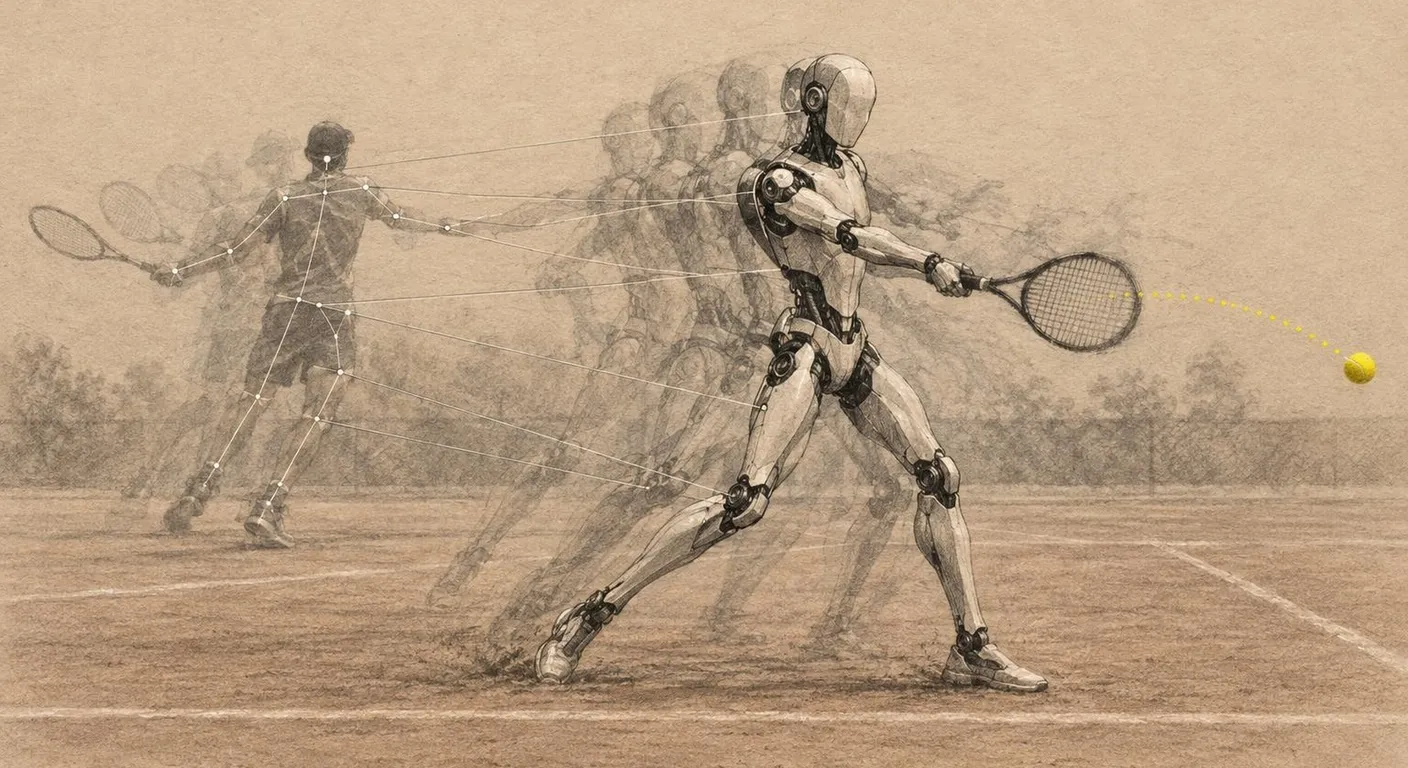
Five hours of amateur tennis footage. That was the training data.
A Unitree G1 humanoid just learned to play tennis well enough to sustain rallies against human players, returning incoming shots traveling at 15 to 30 m/s with a 90% forehand success rate. The research paper, published by Tsinghua University, Peking University, and Galbot, describes the system as LATENT, "Learning Athletic humanoid TEnnis from imperfect human motioN daTa." The phrase doing the most work in that title is "imperfect."
What actually happened
The team did not record professional matches. They did not collect millions of training samples. They put five amateur players in front of a motion-capture rig for a total of about five hours of wall-clock time and ended up with a noisy, fragmented set of motion primitives. No clean takes. No full rallies. Just bits of human movement, mostly wrong in some way.
Then they trained a hierarchical controller in simulation that uses those fragments as soft priors. A Latent Action Barrier keeps the policy's reinforcement-learning exploration close to the distribution of natural human motion, so the robot does not diverge into shapes that would be physically possible but visibly inhuman. Reinforcement learning composes the fragments into full strokes.
On the real Unitree G1, Interesting Engineering reported, the system achieves about 96.5% accuracy in simulation and 90% on real forehand returns, with backhands around 78%. Ball-racket contact is a window of milliseconds. Court sprint speed exceeds 6 m/s. The robot adapts its stance and swing to incoming shots in real time.
The "five hours" caveat
Reddit caught the obvious objection. The five-hour figure refers to wall-clock data collection, not total compute. The model trained for the equivalent of years across massively parallel simulated environments with slightly varied physics, learning robustness through variation. One commenter on r/singularity put it cleanly: the human-clock measurement and the GPU-clock measurement are different things, and the headline number is the human-clock one.
That distinction is the entire point. Compute is fungible. You can buy more of it. The bottleneck that has actually constrained humanoid generalization is the data collection step that requires real humans doing real things, captured well enough to be useful. That step shrank from "millions of curated samples" to "an afternoon."
Why this is not just a tennis demo
Sports are the visually compelling demonstration. Tennis goes viral. Warehouse logistics does not. But the training approach that learned tennis from imperfect motion fragments transfers to any task that needs dynamic human-like coordination: order picking, package handling, manufacturing-cell tending, basic kitchen prep. None of those tasks have clean, abundant motion-capture datasets either.
The robotics industry has been operating on a particular bet for the past three years. The bet is that the value moat in humanoid robotics would be proprietary data: tens of thousands of teleoperation hours per skill, captured by paid operators in controlled environments, that competitors cannot replicate without spending the same amount of time and money. The hardware was always going to commoditize. The data was supposed to be durable.
If five hours of amateur recording produces athletic-grade coordination, that bet looks structurally weaker than the deck slides suggested. Imperfect data, the kind anyone with a few cameras and a motion-capture suit can collect, may be enough.
The replication test
The LATENT code is on GitHub. The Unitree G1 is a commercially available platform. The paper documents the architecture, the training schedule, and the key hyperparameters. A graduate lab with simulation budget and a humanoid platform could attempt replication on a different task next quarter. Whether the result holds will be the proof that matters.
If it does, every robotics company whose pitch deck features a "data flywheel" slide should be ready to explain what the flywheel actually does that five hours of imperfect motion capture cannot.
Why it matters
The pattern this work fits into is not "humanoids are now smart enough to play sports." It is "the asymmetry between data-rich incumbents and everyone else just compressed." That is the same shape as the DeepSeek moment for inference compute, the open-weights wave for language models, and the loss of editing-software moats once generative video tools shipped. In each case, a thing that was supposed to require massive proprietary infrastructure turned out to be reproducible with a fraction of it.
Robotics was the last frontier where the proprietary-data argument still felt structurally sound. It feels less so this week.
Is the real breakthrough the robot playing tennis, or the proof that physical skill transfer no longer requires perfect training data?
Originally published as an Instagram carousel on @recul.ai.