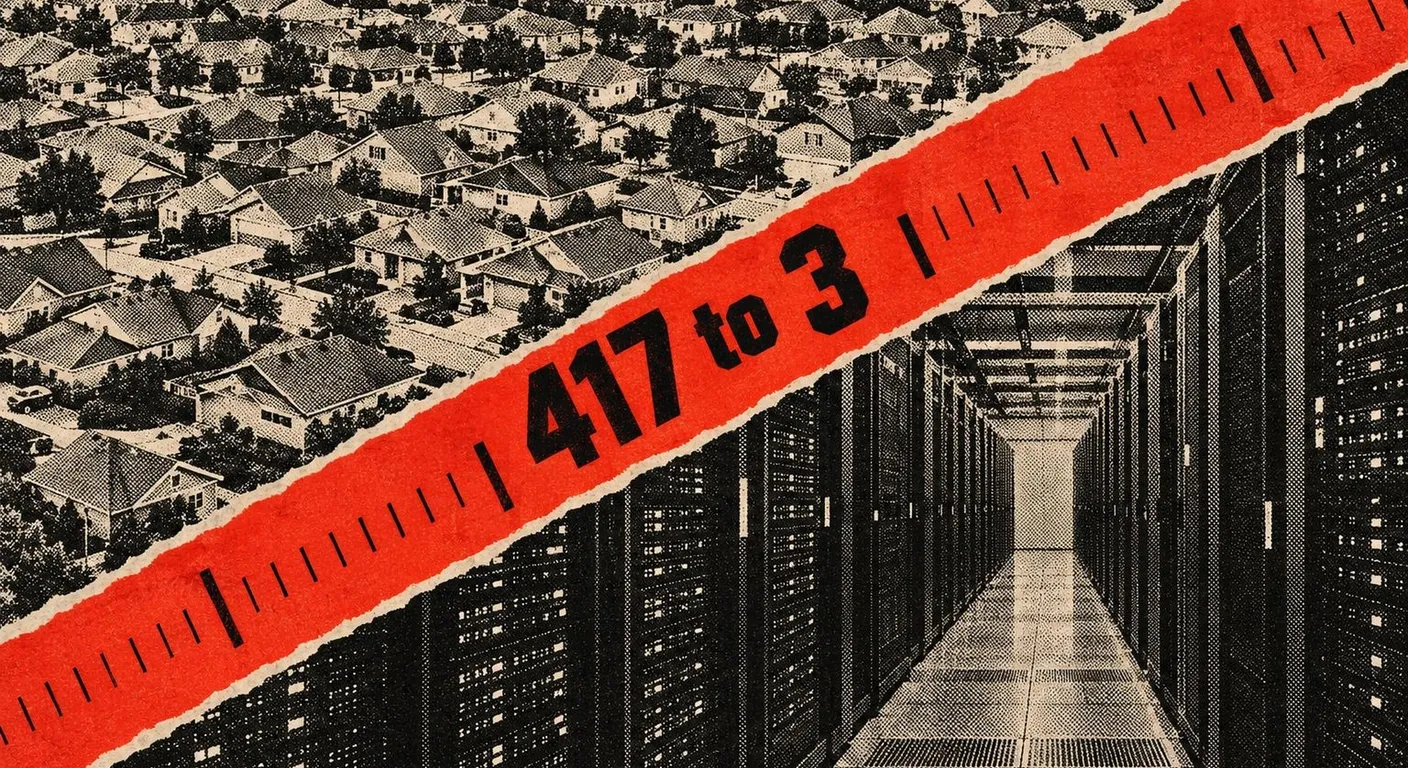
On September 16, the House passed the Ratepayer Protection Act by 417 votes to 3, a margin rare enough to suggest the argument was settled. It was not. The next day, the same bill was stopped in the Senate without a vote.
H.R. 9340 takes up who pays for the electrical infrastructure that AI data centers need. The bill directs state public utility commissions to consider large-load standards for data centers drawing more than 100 megawatts, so operators would cover the full incremental cost of the generation and transmission built to serve them, the House Energy and Commerce Committee said when the bill passed. It rests on Section 111(d) of the Public Utility Regulatory Policies Act, an existing authority under which Washington makes a recommendation while state regulators keep the power to set electricity rules. That second piece is the one to hold onto: commissions are asked to consider a standard, not required to adopt one.
The sponsorship explains part of the 417 to 3. Rep. Gabe Evans, a Colorado Republican, led the bill with Rep. Kathy Castor, a Florida Democrat, and it cleared the Energy and Commerce Committee 52 to 0 in July. Disagreement over data centers tends to run along local lines rather than party ones, which gives both parties a reason to be seen acting on electricity bills.
The Senate stopped it on the day it was offered
On September 17, Senator Jon Husted of Ohio asked the Senate to pass H.R. 9340 by unanimous consent, a procedure that fails if a single senator objects. Senator Martin Heinrich of New Mexico objected, and the request ended there. Heinrich said his objection was to the mechanism rather than the goal: "It is not enough for us to tell States to consider making data centers pay for grid updates. Rather than voluntary pledges or suggestions to States, Congress needs to pass real legislation with real teeth."
Heinrich has introduced an alternative. Heinrich said in the same remarks that the GRID Savings Act is "not a voluntary agreement" and would require large load customers such as data centers to pay for the facilities needed to connect them to the grid.
Why it matters
The bill's reach is smaller than its vote count, and the costs it addresses are already showing up on bills. Monitoring Analytics, the independent market monitor for PJM, the grid region that serves roughly 67 million people, estimated that data center load by itself increased the region's 2025/2026 capacity auction revenues by $9.33 billion, an increase of 174.3 percent. Auction costs are recovered from the customers who pay for the region's power.
Public opinion is lopsided in a similar direction. A University of Massachusetts Amherst poll released September 14 found that 65 percent of respondents opposed construction of a data center in their community, while 11 percent supported it. The Wisconsin Examiner reported that the backlash is already shaping races before the midterms, and it quoted poll director Tatishe Nteta, who said opposition to AI data centers has emerged as "one of these rare areas of consensus."
Critics of the House bill read the consideration requirement as close to nothing. Sara Chieffo of the League of Conservation Voters told the Wisconsin Examiner: "With only a weak directive to states to consider cost protections against the energy costs of data centers for ratepayers, state regulators could ultimately choose to ignore this bill." Heinrich made the same case on the floor in different words.
Where the choice now sits
What happens next does not run through the House floor. A state commission that takes up the standard can write it strongly, soften it, or leave it alone, and those proceedings, not the floor votes, will shape household electricity prices for years. Evans has framed the measure as one that preserves state authority; Heinrich has framed it as one that does too little. The Wisconsin Examiner reported on September 20 that Congress looked stuck on the issue.
The remaining decisions belong to state commissions. When a 100-megawatt load asks for service, does the operator pay for the plants and wires it requires, or do the other customers on that grid?