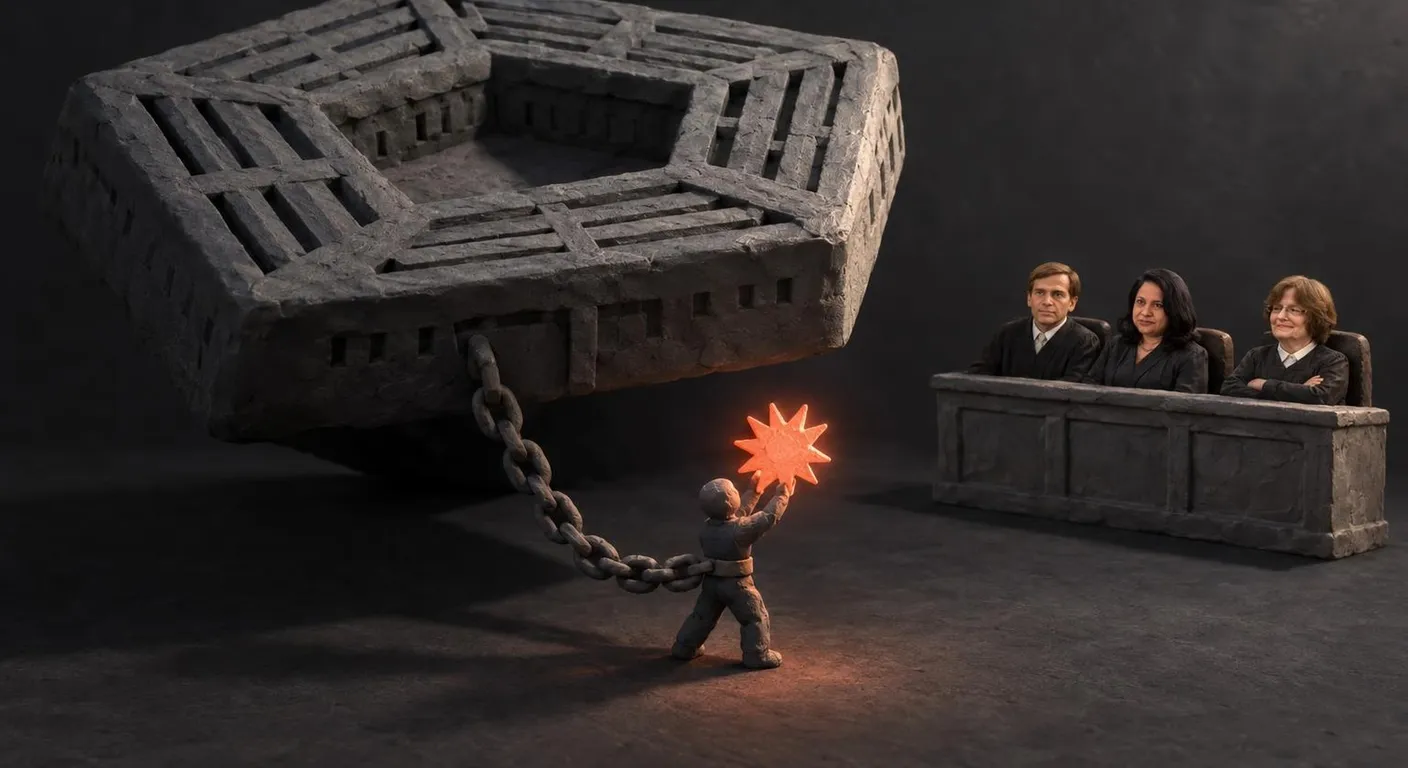
On September 25, 2026, a federal appeals court in Washington allowed the Department of War to keep Anthropic and its Claude AI models out of the department's supply chain. In a 2-1 decision, a panel of the US Court of Appeals for the D.C. Circuit upheld the department's determination that the company is a supply-chain risk, a label that bars the department and the contractors on its business from using Claude. The panel accepted that Anthropic had acted with no bad motive. For a company selling software to the government, the ruling settles an uncomfortable question the government's way: refusing to widen what its product can be used for can cost it the work.
What the label does
A supply-chain-risk designation is an exclusion rather than a fine or a suspension. The appeals court upheld a finding that covers Claude's use by the Department or its contractors, so the military cannot use the company's models, and neither can companies taking Pentagon work that depends on them. The designation does not cover the whole federal government; it applies to this department and the firms serving it.
Why the Pentagon moved
Anthropic had written limits into its defense agreements. The majority opinion records that the department made its decision after the company refused to relax contractual prohibitions on using Claude for lethal autonomous warfare, systems that select and strike targets without a person making the decision, and for domestic surveillance of people inside the United States. Defense One reported that the department sought instead to permit any lawful use of the software. Anthropic declined, and the designation followed.
The two sides had worked together since July 2025, when the department's Chief Digital and Artificial Intelligence Office awarded Anthropic a two-year prototype agreement with a $200 million ceiling, an arrangement known as an other transaction agreement and distinct from a standard contract. The directive to designate the company began on February 27, 2026, and the written determination the appeals court reviewed is dated March 3, 2026. The Associated Press reported that the dispute broke into the open in February, when President Donald Trump and Defense Secretary Pete Hegseth accused Anthropic of endangering national security, and that chief executive Dario Amodei refused to back down.
Two laws, two answers
Two courts have now ruled on the same company under different procurement statutes. In California, Judge Rita Lin found an earlier designation unlawful under 10 U.S.C. section 3252, concluding that Anthropic did not meet that law's definition of a supply-chain risk. The D.C. Circuit reviewed the later determination under 41 U.S.C. section 4713, the Federal Acquisition Supply Chain Security Act of 2018, which, as Ars Technica noted, defines a supply-chain risk more broadly and gives the D.C. Circuit exclusive jurisdiction over challenges brought under it.
The broader wording carried the appeal. Judge Gregory Katsas, writing for the majority with Judge Neomi Rao, accepted the California court's finding that Anthropic acted without bad motive, and held that no bad motive is required under the 2018 law. In that reading, the statute turns on what the department concluded about the risk of keeping the software in its systems, not on the company's reasons for its conditions.
The risks the court left to the president
The opinion treated the choice as one for the executive branch. Writing for the majority, Judge Gregory Katsas said it was the President and the Secretary of War who had to determine how best to balance the competing risks. The two risks the court named were an AI system that stops working in the middle of an operation and one that picks the wrong target in a lethal strike. The court found the Secretary did not exceed his authority under the 2018 law or the Constitution, and that the department had ample support for its conclusion that keeping Claude in its systems presented a national-security risk.
The dissent
Judge Karen Henderson dissented. She read the 2018 law through the history that produced it: Congress acted after the intelligence community asked for legislation against hostile states and other bad actors infiltrating federal systems, a purpose she said supported Anthropic's narrower reading. The law, in her account, was not aimed at a contractor's honest, upfront enforcement of its own restrictions.
The California order is still in place
Judge Rita Lin ordered the parallel designation removed after finding that the government's action amounted to unlawful retaliation that violated the First Amendment, and Bloomberg Law reported that the order appears to remain in effect. That leaves one designation ordered off the books and the other upheld on appeal. The two decisions do not cancel each other; they answer questions asked under different words in the statute book.
What each side said
Anthropic said it respectfully disagrees with the ruling, that another federal court had already held the parallel designation unlawful, and that it remains confident in its position and is considering all options, including further review. The Pentagon's spokesman, Sean Parnell, said the ruling completely validated the department's position. Emil Michael, the department's undersecretary for research and engineering, wrote that no private company would insert its opinions in the chain of command, and that warfighters would sleep better for it.
What comes next
Anthropic can ask the full D.C. Circuit to rehear the case, or petition the Supreme Court. Charlie Bullock, a senior research fellow at the Institute for Law & AI, told Defense One that the company's chances on appeal were good, but that it was not guaranteed to be heard, because the appeals process is discretionary. He also called the outcome unsurprising given the composition of the panel, which was made up of Judges Katsas and Rao, both Trump appointees, and Henderson, who dissented.
POLITICO, analyzing the ruling, called it the first court reading of the executive branch's power under the 2018 law and said it could let the government exclude AI firms and other contractors over their own ethical or product-safety limits.
For now the label stands: Claude is out of the Department of War's supply chain and off the work of its contractors, the order that lifted the parallel designation in California is still in force, and whether a higher court agrees to hear the appeal is undecided.