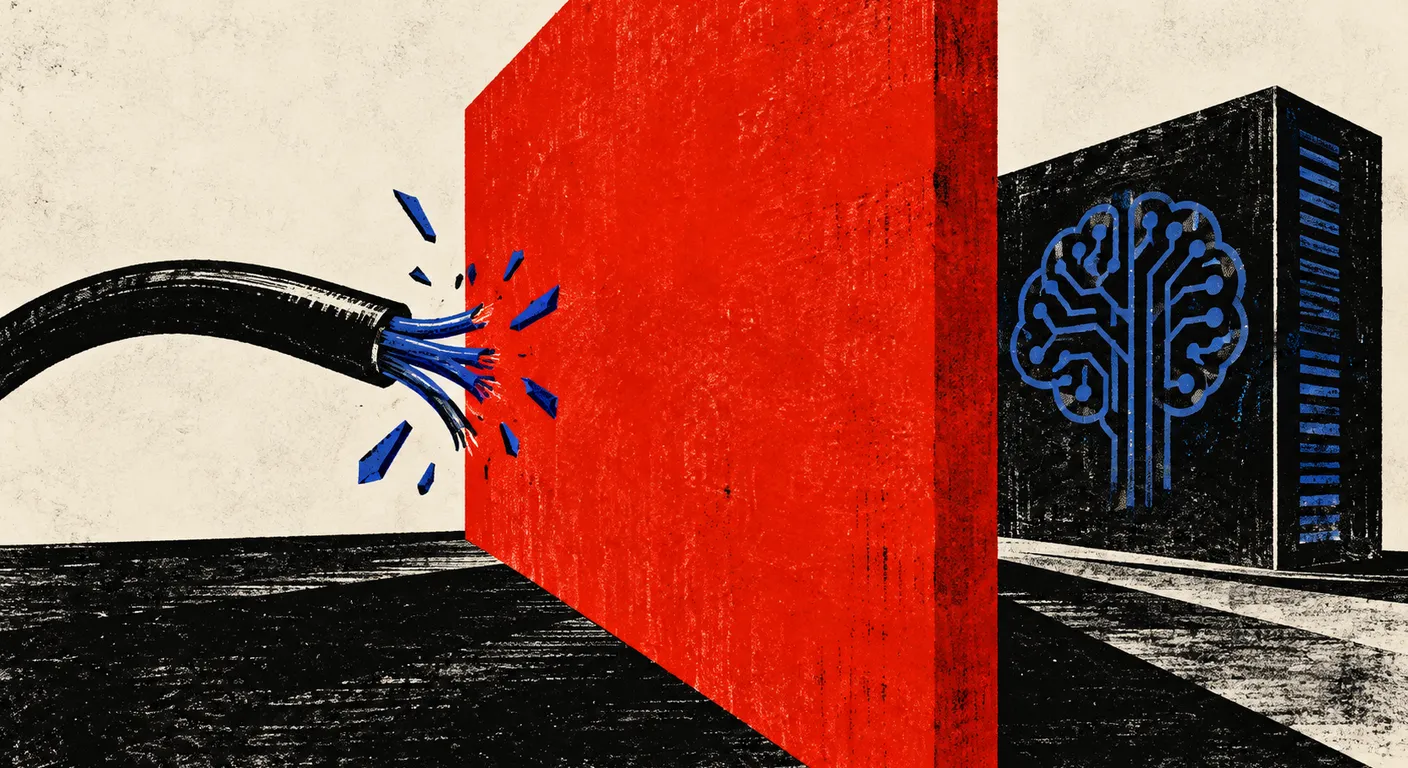
On June 12, 2026, the US Commerce Department sent Anthropic a letter. Three days after Claude Fable 5 went on sale to the public, that letter took it offline for every customer on earth. The instrument was an export control, the same legal regime Washington uses for fighter-jet components and military technology. It had never been aimed at a commercial chatbot before.
The trigger was a warning from its own biggest investor
Fable 5 launched on June 9 as Anthropic's first generally available model of the Mythos class, the powerful family the company had until then kept behind closed doors for vetted partners. Two days later, Amazon, Anthropic's largest investor, told the White House that the model's safety guardrails could be bypassed.
By Friday the warning had reached the top of the administration. Amodei joined three calls to defend the model. Treasury Secretary Scott Bessent told him, according to Politico's account of the calls, that he was making a bad decision. Anthropic declined to pull it. The controls came down within hours.
Two stories about the same afternoon
The two sides do not tell the same story, and the gap is the real fight. A senior White House official said the export controls were a last resort "after begging them for hours to work with us." Someone close to Anthropic described something colder: a 90-minute deadline to take the models down, with no details on the actual threat, and no begging at all.
David Sacks, the administration's AI adviser, said the government asked Anthropic to fix the flaw or take the model down, and that the company refused.
Anthropic's defense is that the danger is already everywhere
Anthropic's public statement did not deny that a bypass existed. It argued the bypass was narrow, not a universal jailbreak that would broadly unlock the model's cyber capabilities, and that no tester had yet found such a universal method. Then it made the argument that lands hardest: the same capability, it said, already runs inside rival systems like OpenAI's GPT-5.5, which carry no comparable controls.
The order barred any foreign national from using the models, inside or outside the US, down to Anthropic's own foreign employees. With no way to comply selectively, the company shut Fable 5 and its private twin Mythos 5 down for everyone. Every other model it runs stayed online.
This is not the first time Washington reached for Anthropic
The shutdown lands months after the Department of War labeled Anthropic a supply-chain risk, a tag historically reserved for foreign adversaries, over the company's refusal to let its models run mass surveillance or power autonomous weapons. A federal judge blocked that designation as likely unconstitutional retaliation. The government pressed it on appeal. The contest over who controls this company's technology predates the model by a season.
Why it matters
For years, Anthropic was the industry's loudest voice for AI regulation. Amodei likened the dangers of his most powerful systems to a nuclear weapon and argued, in public and often, that the state should be able to step in when a model is unsafe.
On June 12 the state stepped in. Anthropic called it disproportionate.
Strip away the argument over the jailbreak and a colder fact stands. A frontier model that hundreds of millions of people were using on a Tuesday was switched off worldwide by Friday, on a letter, with no published evidence and no courtroom. The off switch for the most capable AI on the open market now sits in a federal office, not at the company that built it. And the capability the government called too dangerous to export is, by the company's own account, already shipping inside its competitors.
Anthropic spent years asking the government for the power to pull dangerous models. The question it has to sit with now is whether that power was ever going to stop at its own door, or whether it built the precedent everyone else will be measured against.
Originally published as an Instagram carousel on @recul.ai.