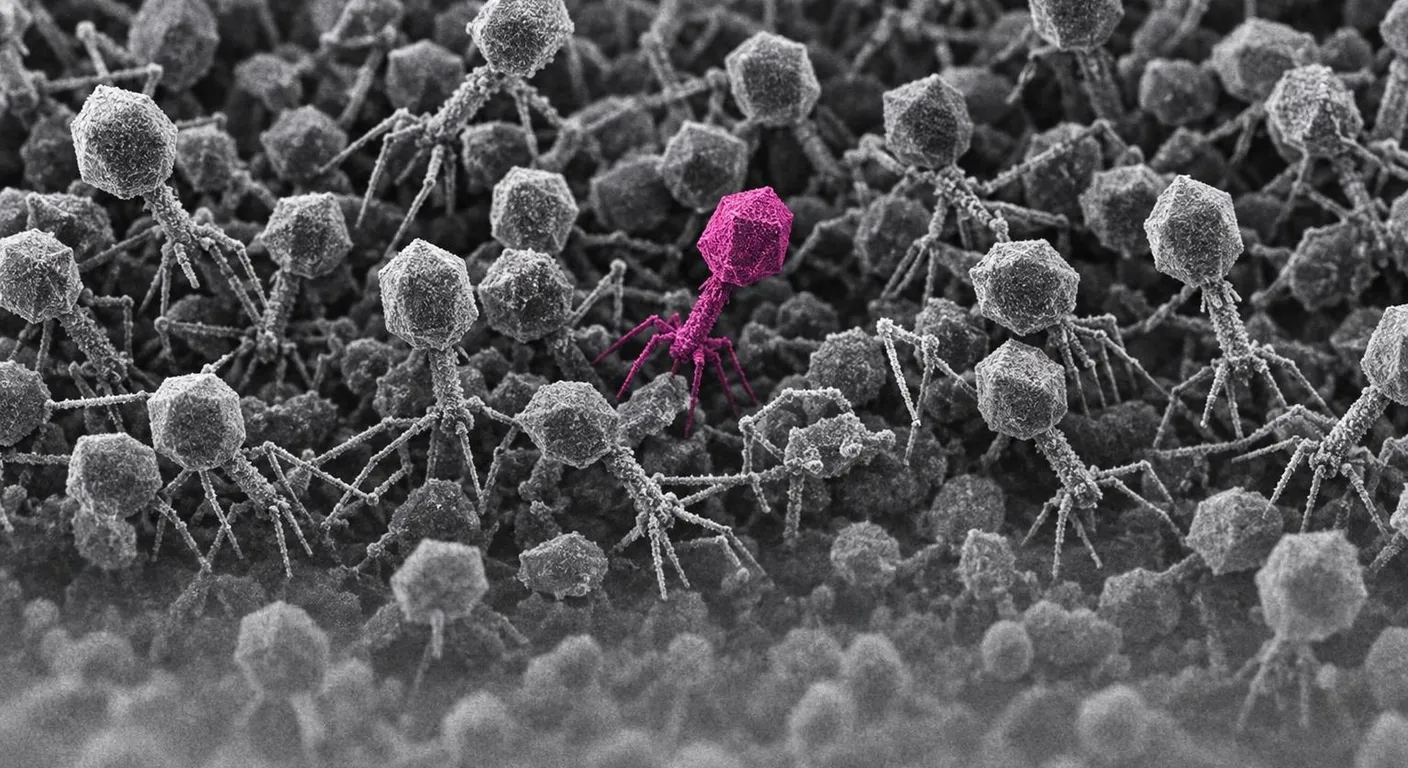
Anthropic said on 23 September 2026 that roughly 950 copies of its Claude AI, set working as agents, spent 21 hours searching a database of DNA and found a repeating pattern in viruses that infect bacteria, one the company says nobody had noticed before. The company named the system ART and noted that the layout of its repeats resembles part of CRISPR, the gene-editing tool; its chief executive, Dario Amodei, announced a "Claude-led discovery" of a molecular machine that could turn out to be a new way to edit genes. What has been shown so far is a structure whose purpose is unknown, no evidence that it edits anything, and a pre-print that outside scientists have not reviewed. A researcher in Copenhagen says his own unpublished doctoral work described the same patterns, so the open question is how much of the find belonged to the machine.
How the search ran
An AI agent is a copy of a model given a job and left to work through it, and Anthropic ran many of them at once over raw sequence data, as the company describes in its write-up of the work. The search was part of a larger move: the same announcement introduced a new life-sciences research group and a wet laboratory in the Bay Area, where leads like this one can be tested at the bench. Anthropic says its own involvement was limited to the initial prompt and the later laboratory work, and that the agents used their own judgment about which candidates looked interesting. They gathered more than 200,000 reverse transcriptases, enzymes that write DNA from an RNA template, picked out 3,500 candidate systems, and narrowed those to 20 that they wrote up as reports a person could read. The pre-print posted on 11 October 2026 describes the survey behind that as spanning 1.9 billion protein clusters. Anthropic also published one agent's reaction to what it found: the DNA beside the gene was "spectacular", it wrote, because it could see "by eye" a tandem repeat array.
What was found, and what it is not
ART, short for array-associated reverse transcriptases, has three parts: a reverse transcriptase that earlier studies had already identified, a partner gene beside it, and a long array of evenly spaced repeats of non-coding DNA, in units of about 200 nucleotides, the letters of genetic code. What makes the combination interesting, according to Anthropic, is that these features have only rarely been found together in other systems. The repeat layout resembles a CRISPR array, which in the gene-editing tool stores the short guide sequences that give CRISPR its aim: they decide which stretch of DNA the enzyme goes after. Anthropic says Claude appears to be the first to notice the array and the partner protein. In lab tests run by human scientists, the array was copied into distinct short RNA molecules when a Staphylococcus phage, a virus that attacks bacteria, infected them, which shows the repeats are used for something without showing what for. Nobody knows what ART does, nothing has been shown to edit genes, and the work has not passed peer review: the pre-print is the authors' own account, not one that outside experts have checked. Anthropic's lab handles only the two lowest biosafety levels and no pathogens that infect humans.
The claim that it had been seen before
Mario Rodríguez Mestre used Claude extensively while completing a doctorate at the University of Copenhagen, and he kept unpublished research there, including drafts of his dissertation and analyses of these systems, on a private Claude account. He told CNN that his work describes the same viral signatures, and that this is not two groups studying similar proteins: "It is essentially the same finding," he said. He is not claiming that Anthropic deliberately took his work, and says he cannot demonstrate it. Instead, he finds it more plausible that considerably more prior scientific knowledge and human direction lay behind the search than the phrase "autonomous discovery" implies. Anthropic did not respond to CNN's emailed request for comment. His account is a claim about his own unpublished work, so nobody outside can yet compare the two bodies of evidence.
What other researchers make of it
Feng Zhang, a CRISPR pioneer at MIT and the Broad Institute, said the work was "genuinely intriguing" and merited further investigation. Aaron Engelhart, an associate professor at the University of Minnesota, told CNN the results are preliminary and "don't demonstrate gene editing or provide a mechanistic picture of exactly what's happening". Ilya Finkelstein of the University of Texas at Austin said the systems "are really good at grunt work when orchestrated by experts in the field", and noted that four of the six authors are senior molecular biologists. Gustavo Sudre of King's College London says the shift is real: an agent took a broad direction and then used its own judgment about what mattered in the data, but he also says that "the gap between 'interesting pattern' and 'useful knowledge' is where most of the work lives". Yuval Elani of Imperial College London points out that biology still has to be tested in the physical world, and that today's robots are not close to doing the fiddly, one-off tasks a student would do almost instinctively.
What would settle it
The same family of enzymes is already being mined by human labs: Columbia University researchers described DRT10, a bacterial defence system that writes DNA from an RNA template and is closely related to telomerase, the enzyme that maintains the ends of human chromosomes. Shares of gene-editing companies fell shortly after the announcement, CNN reported. As things stand, the case that a machine made the discovery rests on Anthropic's account of who did what, and the case that it had been seen before rests on a dissertation nobody else has read. Anthropic says its work to understand what ARTs do is ongoing. Until someone demonstrates a function for ART, or Mestre's manuscript becomes public, neither question can be settled.