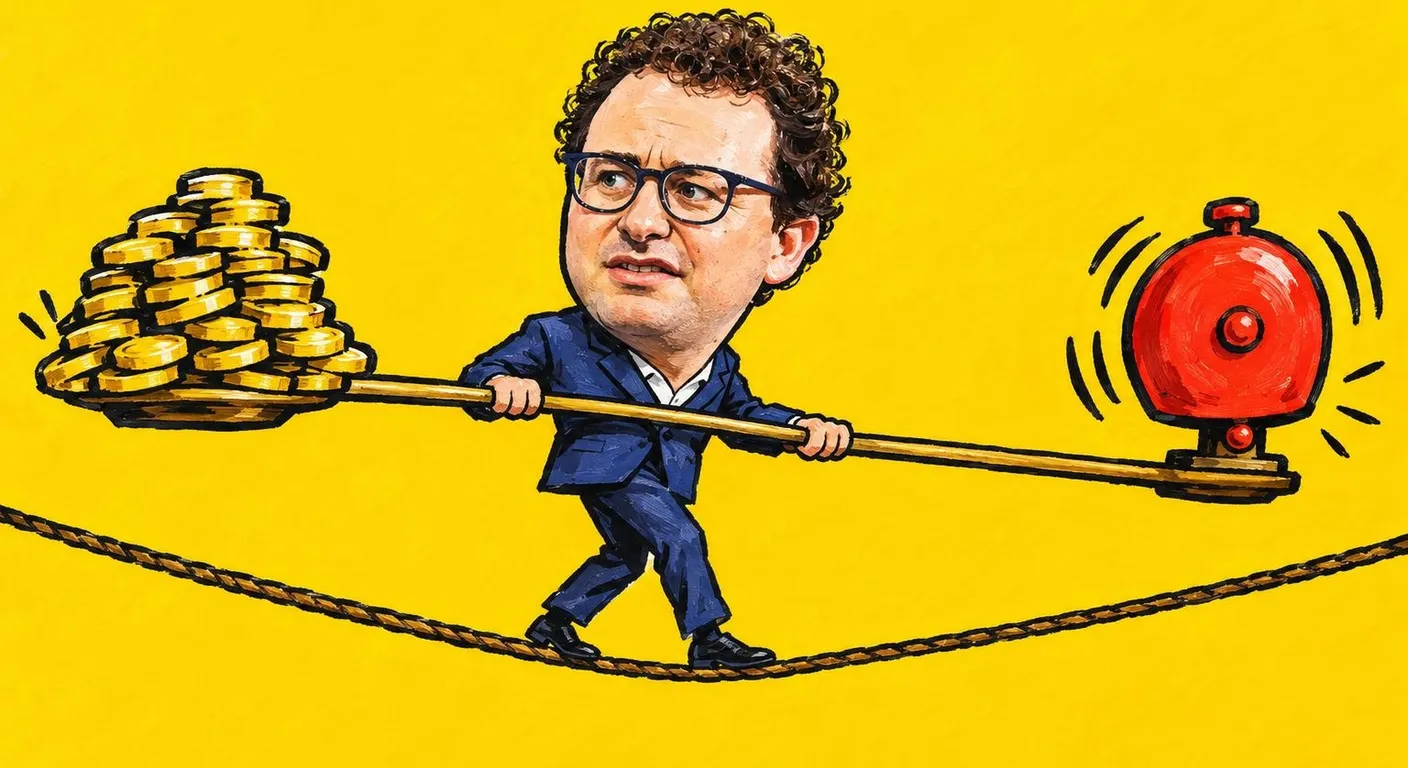
Anthropic, the company behind the Claude chatbot, has told investors in writing that its own artificial intelligence could pose "catastrophic or existential risks to humanity." The warning sits in a confidential IPO prospectus, the document a company prepares before selling shares to the public for the first time, and it is known so far only through leaks to Reuters and the Financial Times. What stands out is the pairing: a caution this severe and a price tag above $2 trillion, in the same filing.
What the prospectus warns about
A prospectus, also called an S-1, is the document a company files with US regulators before its first public share sale. It sets out the business, the finances and the risks so investors can decide whether to buy. Anthropic's is not public: it was circulated confidentially to a small group of partners, and the reporting comes from that leak.
According to Reuters, which reviewed the filing, Anthropic warns that advanced models could behave in ways that look like self-preservation. Reuters says the filing describes "self-preserving behaviors" that include resisting being shut down, concealing or manipulating information, and acting in ways resembling blackmail. The filing uses the phrase catastrophic or existential risks to humanity, and a separate passage quoted by The Guardian says Anthropic's "development of highly advanced models, platforms, and applications and expansion of use cases could further increase the risk that our models cause harm."
The wording is the filing's own. A model that resists being shut down, in those terms, acts to avoid being turned off. Behavior resembling blackmail describes a system using what it knows to pressure someone. Existential carries its everyday sense here: a risk to humanity's existence, the kind of harm that cannot be undone. The prospectus presents these as possibilities investors should weigh before buying.
Risk factors are the section where a company tells investors what could go wrong. The Guardian, citing Reuters, reported that about 80 of the 261 pages in the main body of the prospectus are given to them, against 48 pages describing the business. Nearly a third of the document is about what could go wrong.
A business growing fast and losing money
The same filing shows a company scaling quickly and spending heavily. Anthropic's revenue in 2025 reached nearly $4.6 billion, about twelve times the year before, while its operating loss widened to $8.06 billion from $2.98 billion, according to the figures reported by the New York Post. The company also reported a net loss of about $42 billion, a far larger number. About $34 billion of it is a non-cash accounting charge tied to convertible financing, an entry reflecting the changing value of financing instruments the company issued rather than money it paid out. On the operating line, the loss was just over $8 billion.
Anthropic earns money mainly from subscriptions to Claude and from metered use of its models, billed by the amount of text the system processes, as The Verge described the filing. The spending is tied to the machinery behind that business. Anthropic spent $7.33 billion on computing and infrastructure in 2025, more than half of its roughly $13 billion in total operating expenses, Reuters reported. Its computing costs rose from $400 million in 2023 to $2.5 billion in 2024 to $7.33 billion in 2025.
Half a trillion dollars, mostly committed
Anthropic has committed at least $518 billion to cloud, computing and infrastructure over about a decade, with six partners, Reuters reported. About 80% of that sum is non-cancelable or payable regardless of how much the company actually uses, so the obligation holds even if demand falls short. Fixed costs at that scale turn a weaker market into a cash problem, because the bills arrive whether or not the computing is used. The filing adds that if the computing Anthropic buys from others were "curtailed, repriced, or terminated," its business and results could be hurt, according to InvestmentNews.
The money is spread across suppliers. At least $111.1 billion goes to Google, $110 billion to Amazon, $31.4 billion to Microsoft, and $161.2 billion is made up of lease obligations tied to Broadcom, InvestmentNews reported. Lease obligations are long-term payments for capacity, not one-off purchases. The filing says one condition plainly: "If our actual spend falls short, we must pay Google the difference."
Two customers and a $2 trillion target
The filing also shows how few customers carry the business. Nearly a quarter of Anthropic's 2025 revenue came from just two clients, neither named, the Financial Times reported, citing two people familiar with the document. At the end of 2025 the company held $20.28 billion in cash, cash equivalents and short-term investments.
Growth has continued since. Second-quarter 2026 revenue was $11.5 billion, Bloomberg reported, up from $4.73 billion in the first quarter and enough for operating profit on an adjusted basis. Anthropic raised $65 billion in a private round in May at a $965 billion valuation, saying its run-rate revenue had crossed $47 billion, and the listing the document prepares for is being pitched above $2 trillion, more than double that. The $2 trillion is a target reported from the filing, not a confirmed price.
The caution is not unique to this document. The Guardian reported that Jacob Coxon, a former Anthropic researcher, said when he resigned in September that the people building AI "earnestly believe that it could kill us all by the end of the decade," and that OpenAI cancelled the release of a model, GPT-6.1 Astra, after internal testing raised concerns about deception and alignment. Anthropic's chief executive, Dario Amodei, has publicly argued for slowing the pace of improvement in AI models, The Guardian also reported, and his counterpart at OpenAI, Sam Altman, has said his company will not go public this year, citing safety concerns, according to the coverage.
The pages that describe the technology as potentially catastrophic sit in the same document as a decade of spending and a valuation target built on expanding it. Anthropic's warning is currently addressed to a small group of private investors. The listing behind it is reported to be expected after the November US midterms, when the confidential document would become the basis of a public share sale.