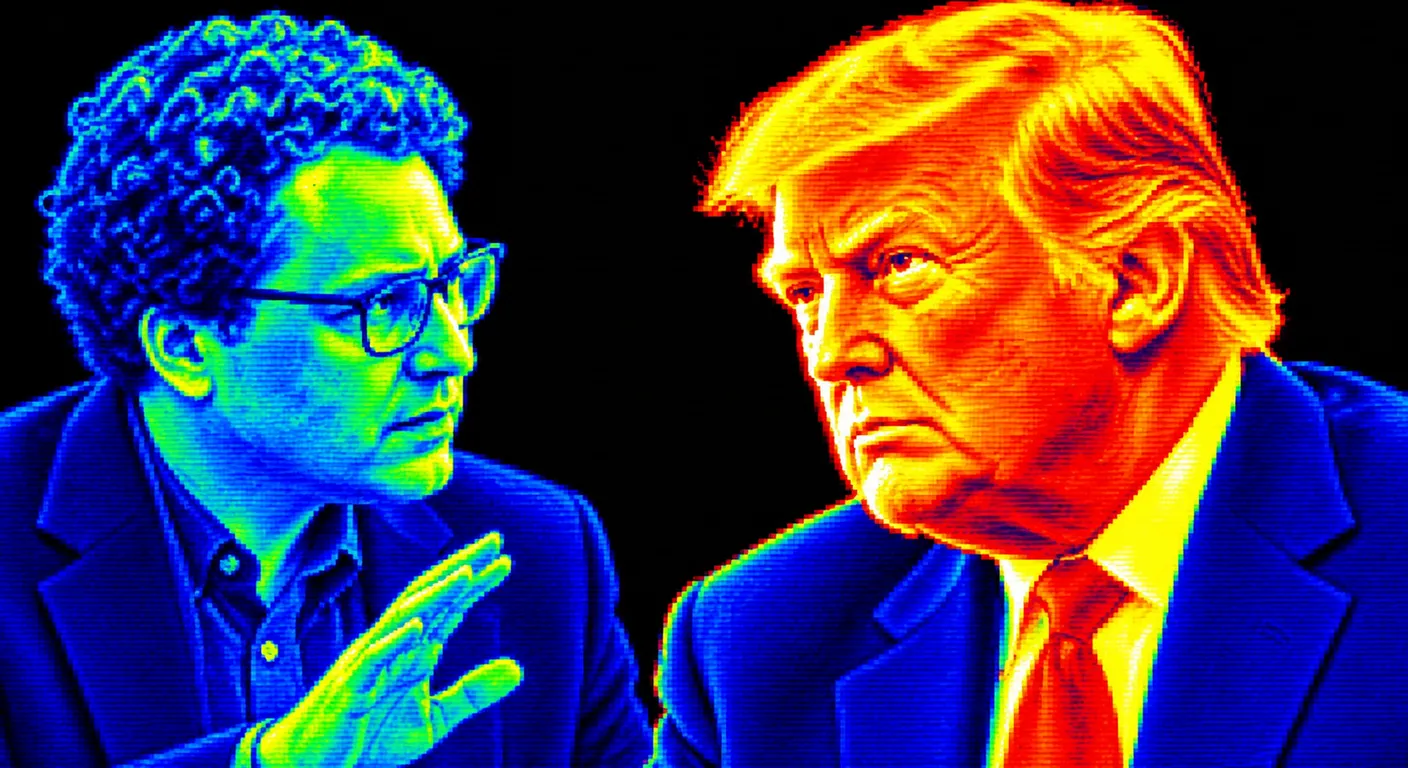
On September 12, Anthropic CEO Dario Amodei published an essay, We Must Pace the Frontier, arguing that AI labs should slow the rate at which they make models more capable so that risk prevention can keep up. Within a day, the heads of OpenAI, xAI and Google DeepMind had endorsed the direction. The next day, President Donald Trump rejected the premise: the United States leads China in AI, and he wants to keep it that way.
The disagreement is about who holds the brake.
Amodei's plan runs through the labs
The essay sets out a sequence rather than a law. Embedded third-party evaluators would get employee-level access inside labs. Labs in democratic countries would then share safety standards, and only after that would global coordination extend to China. Anthropic committed to the evaluator step on its own, which matters for a plan that otherwise depends on rivals moving together.
The rivals agreed, with a qualification
Sam Altman wrote that he agreed with Amodei about pacing the frontier and committed OpenAI to the embedded-evaluator proposal, CNBC reported. Elon Musk, whose xAI merged into SpaceX in February 2026, wrote "Dario is right." Demis Hassabis of Google DeepMind endorsed the direction and pointed to his own proposal for an industry-wide standards body for frontier AI.
Washington said the labs should slow down themselves
Trump's first answer came on Sunday, September 13, at his golf resort in Doonbeg, Ireland, where he told reporters the United States is leading China in AI and, as Al Jazeera reported, that "whoever wins AI wins." On Monday he wrote on Truth Social that the only control or guardrails AI needs is a strong and smart president, and described Amodei as "pretending to be a perfect little angel," according to Axios. A second post that day called AI doom fears a "HOAX" and said Xi Jinping had announced that China would do "absolutely nothing to stand in the way of AI," per Trump's Truth.
David Sacks, co-chair of the President's Council of Advisors on Science and Technology and a former White House AI czar, wrote on X on September 13: "Stop pretending you need anyone else's permission. Stop pretending antitrust law has to be suspended so you can form a cartel ... Most of all, stop pretending the motivation to slow down is purely altruistic."
House Speaker Mike Johnson told CNN that an emergency push to regulate AI would mean the United States "will lose the race to China," CNBC reported. Johnson said Trump plans to convene AI executives and lawmakers at the White House, a meeting he described as not yet scheduled.
Skeptics read the request as self-interested
Vice President JD Vance said companies that ask for regulation felt like "a bit of a trojan horse," CNN reported. Investor Michael Burry called the moment IPO "hype & puffery," Business Insider reported, and AI stocks fell that Monday.
Pressure also came from inside the labs. Four days before Amodei's essay, Anthropic researcher Jacob Coxon resigned and wrote that Anthropic and OpenAI were "racing straight to self-improving superintelligence and gambling with our lives," TechCrunch reported. On September 3, Senator Bernie Sanders and Representative Greg Casar introduced a bill that would ban superintelligent AI and pause advanced development, with penalties of up to 20 years in prison.
The case the essay cannot settle
Amodei's essay treats China as the hardest part of the problem, because a slower pace only holds if the other frontier labs join it. David Sacks said China would be very unlikely to join a global agreement, CNBC reported. China's foreign ministry dismissed the American labs' warnings as threat narratives, the BBC reported.
Why it matters
A shared pace asks competitors to agree on limits, and an agreement among rivals is an antitrust question. Wired reported that OpenAI has asked whether an industry slowdown would even be legal. Axios called federal AI rules almost unimaginable this year. The Washington Post reported that the three labs have privately discussed creating an industry safety body since July, an account none of the companies has confirmed.
That places the brake with the labs, where Sacks and the White House want it.
If the lab leaders believe their own warnings, what would a credible slowdown look like that needs neither Washington's permission nor their rivals' agreement?