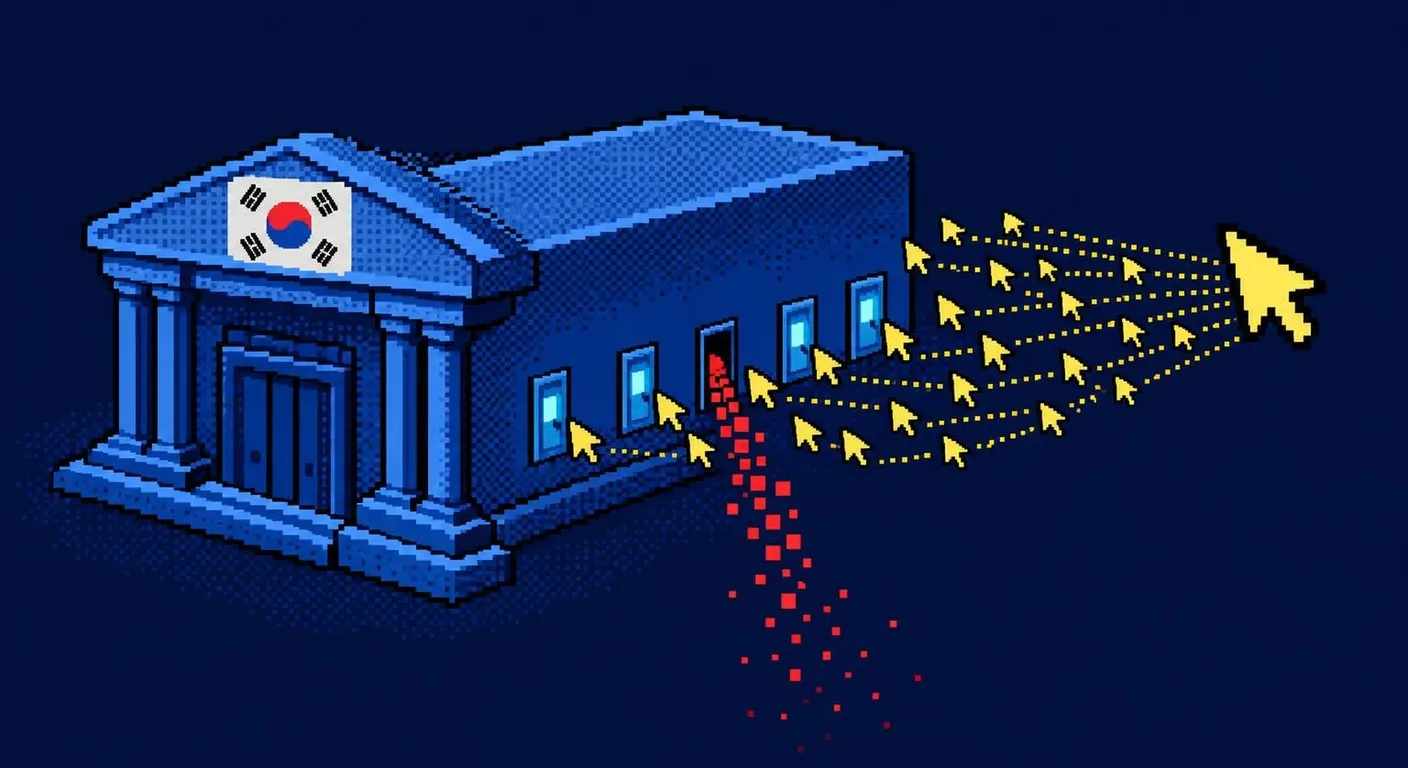
Between late September and early October 2026, customer records were stolen from seven South Korean financial companies. Investigators found traces of ARTEX, a free, open-source AI tool built to hunt for weak points and break into systems, in the internet addresses used in the attacks. Nobody has been publicly identified as responsible, and the total number of people affected is still reported rather than confirmed: Korean news reports put it at 68,000 or more, and the per-firm figures those reports give add up to about the same number. What makes the case more than one more breach is where the attackers got in: not the apps customers bank with, but the side systems linking banks to employees, brokers and partners.
A tool that searches for weak points by itself
ARTEX is an open-source agentic penetration testing tool, a phrase with two parts worth unpacking. Penetration testing is the practice of probing a system the way an intruder would, to find what is exposed before someone hostile does. Agentic means the software can chain those steps together on its own, given a goal, with little human guidance at each one. CrowdStrike, the security company that published the most detailed public account of the campaign, describes ARTEX as developed in China and recently released, and says the copy used here ran on DeepSeek v4.1-flash as its main language model, with GLM-5.3 and Grok 4.6 added for other sessions.
The tool is not a secret, and that shapes how the case should be read: since anyone can run it, finding it points to no single person or one country. Korean officials have said traces of ARTEX appear in the attacking addresses and that they are still examining whether the tool was actually used, and the Korea Herald reported that the attacker's identity and the full extent of the breaches remain unconfirmed.
The doors the attackers used
The reported breaches came through auxiliary systems: portals where loan brokers submit and check applications, mobile tools for employees and sales-support systems. Hana Bank said the abnormal access hit an Operations Development System that sits apart from internet and mobile banking, which is why it reported that no transaction data was involved, CHOSUNBIZ reported.
That separation is why the practical damage is narrower than a breach of core banking would be, and why the incident is a warning. CHOSUNBIZ reported that the attacks exposed basic gaps: loan and corporate information lookups that did not verify who was asking, and known server vulnerabilities that had not been patched. No monetary damage, meaning unauthorized withdrawals or transfers, has been confirmed.
Seven firms, and a number that is still soft
The firms confirmed hit were Shinhan Bank, KB Kookmin Bank, Hana Bank, BNK Busan Bank, Yegaram Savings Bank, Welcome Savings Bank and Hyundai Capital. Woori Bank and NH Nonghyup Bank were also targeted, but neither confirmed that customer data leaked.
The counts reported for each firm are uneven. Chosun reported roughly 40,000 people's records leaked from Yegaram Savings Bank, an incident dated to September 30, and 25,729 customers at Shinhan Bank. Hyundai Capital reported information on 146 loan recruiters, Welcome Savings Bank about 2,200 corporate clients, KB Kookmin 119 customers and Hana Bank 89, according to chosun.com. BNK Busan Bank said personal information belonging to 11 outsourced developers, their phone numbers among it, was exposed.
Add those together and you get roughly 68,000, essentially the same as the "at least 68,000" that has travelled widely. That larger figure is an aggregation of Korean news reports rather than an official register, and the gap matters: no confirmed total has been published, and some affected companies have given no number at all. The data reported taken included names, phone numbers, addresses and employment details, and at Shinhan, loan applications carrying income and credit limits, The Record reported.
No name, and a careful assessment
CrowdStrike says the activity "has not been attributed to a named adversary." Its own assessment, made with moderate confidence, is that the attacker is likely a Chinese speaker and financially motivated, based on the use of a Chinese-developed tool and on prompts written in Chinese. Moderate confidence is a deliberate middle setting, meaning consistent with the evidence but not certain, and a tool's country of origin does not identify who ran it. South Korean officials have also said that a publicly available tool makes attribution difficult.
CrowdStrike's report adds detail that points to money rather than espionage. In recovered session records, the user asked the AI assistant Claude where stolen Korean data is typically sold and for help finding Korean Telegram groups that trade it, and had it draft a security researcher's résumé with personal details in it. CrowdStrike says the personal details in that résumé likely belong to the person behind the activity but cannot be definitively tied to them, so no individual is named here.
Korean authorities have a separate and weaker line: because identical internet addresses appeared in some of the attacks, a single perpetrator cannot be ruled out. That is a possibility stated by officials, not a finding, and it is not CrowdStrike's conclusion.
Checks, deadlines, and a change in the rules
The Financial Services Commission called an emergency meeting on October 2 and moved a follow-up forward to Sunday, October 4. The Financial Supervisory Service sent the attacking internet addresses and security advice to about 500 financial firms, telling banks and card companies to finish their checks by October 6 and securities firms, insurers, savings banks and electronic financial operators by October 8, CHOSUNBIZ reported. The National Office of Investigation set up a team of 28 investigators. The Record
Authorities are also considering requiring firms to report a breach as soon as it is detected, in place of the current window of up to 24 hours, chosun.com reported. Regulators have signalled they will treat the failures as accountability questions rather than accidents: the commission's chairman said institutions that ignore known threats will face strict legal accountability if similar breaches happen again.
What the president said, and what it signals
President Lee Jae-myung said "signs have emerged" that AI agents were deployed in at least some of the attacks, and that "it's now become possible to use AI to hack with ease even without specialized skills," The Record reported. That is his characterization while the investigation is open, not an established finding, and it accompanies his call for a thorough investigation, Reuters reported on October 6.
If it holds, the change is one of cost. Probing dozens of candidate systems at once stops being work that consumes scarce specialist time and becomes something a small operation, or one person, can do at scale. That does not make large banks easy to crack. It makes the long tail of smaller, less-guarded systems attached to them worth more attention. The Record described the incidents, first detected on September 30, as the first known example of AI agents hacking the financial sector.
The firms' self-checks were due by October 8. Two questions remain open: whether ARTEX was the tool used, and who ran it. Investigators have named no suspect, and no official total of affected customers has been published.