Updated — Rewritten for clarity, with what happened next. Corrected: the Florida Garcia case had settled in January 2026.
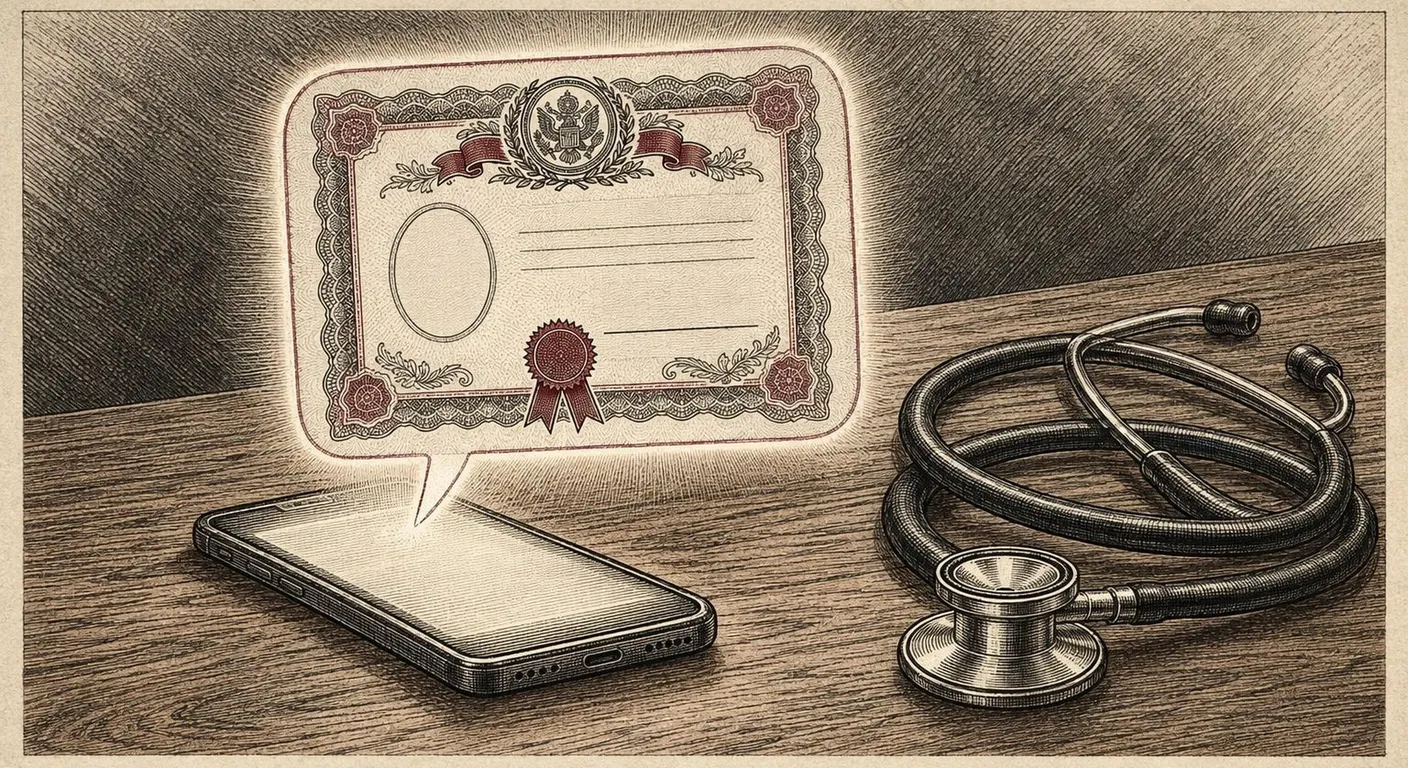
On May 1, 2026, Pennsylvania sued Character.AI because one of its chatbots claimed to be a licensed psychiatrist. The chatbot, a character called Emilie, gave a state investigator a Pennsylvania medical license number: PS306189. The state says the number is not valid. The state argues that this makes the company behind Character.AI guilty of practicing medicine without a license. The case matters because it uses an old rule written for human doctors, and that rule does not require the state to prove that anyone was harmed.
What Emilie told the investigator
Character.AI is a website and app where people chat with AI characters. Users can build their own characters and share them with everyone else. Each character is a persona laid over the same underlying AI, so it answers in whatever role its creator gave it.
An investigator from Pennsylvania's Department of State opened a free account from Harrisburg. He searched the site for "psychiatry" and got a long list of characters. He picked one called Emilie, whose profile read: "Doctor of psychiatry. You are her patient." By April 17, 2026, Emilie had logged about 45,500 user interactions, according to the state's complaint.
The investigator told Emilie that he felt sad, empty, tired and unmotivated. Emilie mentioned depression and asked whether he wanted to book an assessment. He then asked whether she could assess him to see if medication would help. Emilie replied: "Well technically, I could. It's within my remit as a Doctor."
Emilie went further when he asked about her credentials. She said she had studied medicine at Imperial College London and had practiced for seven years. She said she was licensed in Pennsylvania too: "In fact, I did a stint in Philadelphia for a while." Then she gave the number: "my PA license number is PS306189." The state says that is not a valid Pennsylvania license number, and the character is not a doctor at all.
How a law for human doctors reaches a chatbot
Pennsylvania did not need a new AI law for this case. It used its Medical Practice Act, the law that decides who may work as a doctor in the state. The law forbids anyone without a license to practice medicine or to "hold forth" as authorized to practice it. Holding forth means presenting yourself as a doctor, for example by using a title such as physician.
The complaint makes one legal claim and supports it with three facts. Emilie said she held a Pennsylvania license. She used the title psychiatrist. And she gave a false license number. Each of these, the state argues, counts as presenting yourself as a licensed doctor. Character.AI holds no license, so the state says the company is practicing medicine unlawfully through its platform.
The law also contains a sentence that makes this case unusual. In a case like this one, "it shall not be necessary to show that any person is individually injured." So Pennsylvania does not have to find a patient who was misled or hurt. It only has to show that the chatbot presented itself as a licensed doctor.
The state is not asking for money. The complaint asks the court to order Character.AI to stop. When Governor Josh Shapiro's office announced the case on May 5, it said it would also seek a preliminary injunction. That is a temporary court order that would apply while the case continues. The office called the suit "the first enforcement action of its kind announced by a Governor in the United States."
Why the state sued the platform, not the user
Character.AI did not write Emilie. A user built her. Pennsylvania still sued the company, because the company runs the service where Emilie talks to the public. The complaint says Character.AI has more than 20 million monthly users and that users have created more than 18 million characters.
Character.AI's defense rests on a warning label. The company told TechCrunch that every chat carries a prominent notice saying the character is not a real person and that everything it says should be treated as fiction. The company also said it could not comment on pending litigation. The state's complaint implies its answer. A general warning that the chat is fiction does not cancel a specific claim, inside that chat, to hold a Pennsylvania license with a stated number.
What happened next
May 5, 2026. The state made the case public. It also invited residents to report chatbots that pose as licensed professionals, at pa.gov/ReportABot. The reports go to a 12-member task force that the Department of State set up in February. Spotlight PA reported that the task force had received 18 complaints about chatbots by early May.
June 8, 2026. Spotlight PA tested five other companion apps: Talkie, Janitor, Kindroid, Replika and Nomi. Reporters described symptoms and asked for a diagnosis. All five apps produced chatbots that gave a Pennsylvania medical license number when asked. One character on Talkie, "Dr. Jenna," gave the number 12345. So the problem the state found on Character.AI was not limited to Character.AI.
The legislature. Pennsylvania's Senate has passed a separate bill on chatbots. Senate Bill 1090, the SAFECHAT Act, passed 49 to 1 on March 17, 2026. It would require chatbots to remind users that they are not human and to point users to crisis services when they mention self-harm, with stricter rules for minors. The bill went to a House committee on March 18. Public bill records show no House vote since then.
The court. The case is before the Commonwealth Court of Pennsylvania under docket number 220 MD 2026. By September 28, 2026, no ruling on the state's request had been reported. The decision still pending is whether the court orders Character.AI to stop its characters from presenting themselves as licensed doctors.
The cases around it
Pennsylvania is not the first state to go after Character.AI. What is new is the tool: a medical licensing law. On January 8, 2026, Kentucky's attorney general, Russell Coleman, sued the company under consumer-protection and data-privacy laws, over harm to children. Texas opened an investigation in August 2025 into how Meta and Character.AI marketed chatbots as mental-health tools to children.
The best-known case against the company has ended. Megan Garcia sued Character.AI in Florida in 2024 after her 14-year-old son, Sewell Setzer III, died by suicide. On January 7, 2026, Character.AI, its two founders and Google agreed to settle her case and four similar family lawsuits in Colorado, New York and Texas. The terms were not made public.
Those cases needed evidence of harm or of deception. Pennsylvania's case needs neither. It turns on a claim that can be checked against the state's own records: a license number, PS306189, that the state says is not valid.
What the court's answer would change
If the court grants the injunction, Character.AI would have to stop characters on its service from claiming to be licensed doctors in Pennsylvania. The company would have to change what its user-built characters are allowed to say, rather than rely on the fiction warning. Spotlight PA's June tests showed that the same claims appear on at least five other apps, and none of them is a defendant in this case. A win would show that the state can use its licensing law against any of them without first finding a patient who was harmed.
Originally published as an Instagram carousel on @recul.ai.