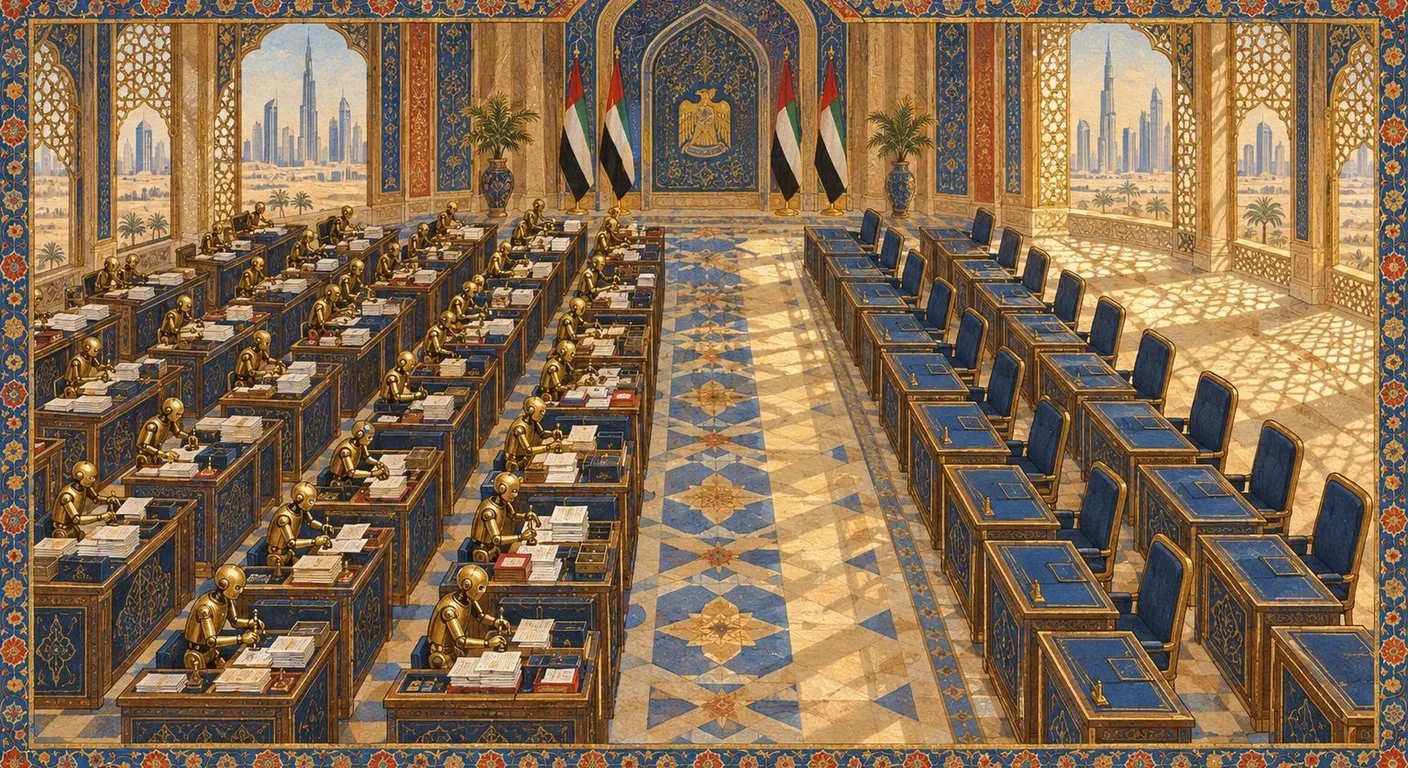
On April 23, 2026, Sheikh Mohammed bin Rashid Al Maktoum announced that 50% of the UAE's federal sectors, services, and operations will be moved to autonomous AI agents within two years. Read that sentence again. The plan is not for chatbots. It is for systems that monitor, decide, execute, and improve without waiting for a human at every step. If the UAE delivers, it will be the first government to put AI inside the operating layer of public administration at this scale. Whether it works is one question. What happens when it makes a wrong decision is the harder one.
That second question is what nobody is asking yet.
The directive is not about chatbots
The framing matters because most coverage collapsed it. Sheikh Mohammed posted on X that "AI is no longer a tool. It analyses, decides, executes, and improves in real time." The word the announcement turned on is "agentic." The plan, under directives from UAE President Sheikh Mohamed bin Zayed Al Nahyan, is to redesign workflows so AI systems take routine actions on their own. Federal employees will be trained, but their role is supervising the system, not running the queue.
That is a different scope from the AI deployments most other governments have announced. Estonia automates digital services. Singapore runs pilot programs in narrow domains. China's AI Plus initiative targets broad sector adoption by 2027. None of those go to 50% of government operations handed to autonomous agents within two years.
A long runway, not a trial balloon
This is also not the UAE's first AI bet. In October 2017, the UAE appointed Omar Sultan Al Olama as the world's first Minister of State for AI and launched the National AI Strategy 2031 in the same announcement. In April 2025, the Cabinet approved an AI-powered legislative system designed to draft and review laws. The 2026 announcement is the next step in a strategy that is now in its ninth year.
The credibility of the timeline depends on that. Bold-AI announcements are easy. A nine-year arc with named roles, ratified strategy documents, and a deployed legislative system carries different weight.
Accountability has a name. Appeal does not.
Here is where the analysis gets uncomfortable. Oversight sits with Sheikh Mansour bin Zayed Al Nahyan, the Vice President. A dedicated task force coordinates execution across ministries. The chain of command is short and named. That is the strength of the federation's centralized model: a directive from the Presidential Court can move every ministry in a single quarter.
It is also the limitation. Efficiency is the easy argument, and the UAE will get it. A system that reads files, routes cases, and executes routine compliance steps will make government faster. But what happens when an autonomous agent denies a permit, flags a resident, changes a regulatory threshold, or recommends enforcement against a business?
The citizen needs a visible path back to a responsible human. As The Decoder noted, systems that make decisions on their own can make errors and amplify biases, and oversight is especially important where press freedom and democratic checks are limited. The UAE is a federation of hereditary monarchies. There is no elected national legislature, no opposition press, no independent judiciary in the form a Western reader assumes. An appeals process is not a piece of the architecture you bolt on later. It is the condition that makes the whole experiment legitimate.
Why it matters
The UAE is doing the experiment first because it can. A federation of monarchies with a centralized cabinet can move faster than any democracy on this kind of restructure. Other states will watch what happens. If the rollout works, governments with more diffuse authority, like France, Germany, or India, will face pressure to copy a model that took two years instead of two decades. If it fails, the cost will not be borne by the system. It will be borne by whichever residents got the wrong answer from the workflow first.
That is the trade nobody is debating yet. We are still arguing about whether agentic AI works. Within two years, we will be arguing about who answers when it does not.
The future of AI governance may not arrive as a law. It may arrive as a workflow.
When AI can execute government decisions, what has to stay human?
Originally published as an Instagram carousel on @recul.ai.