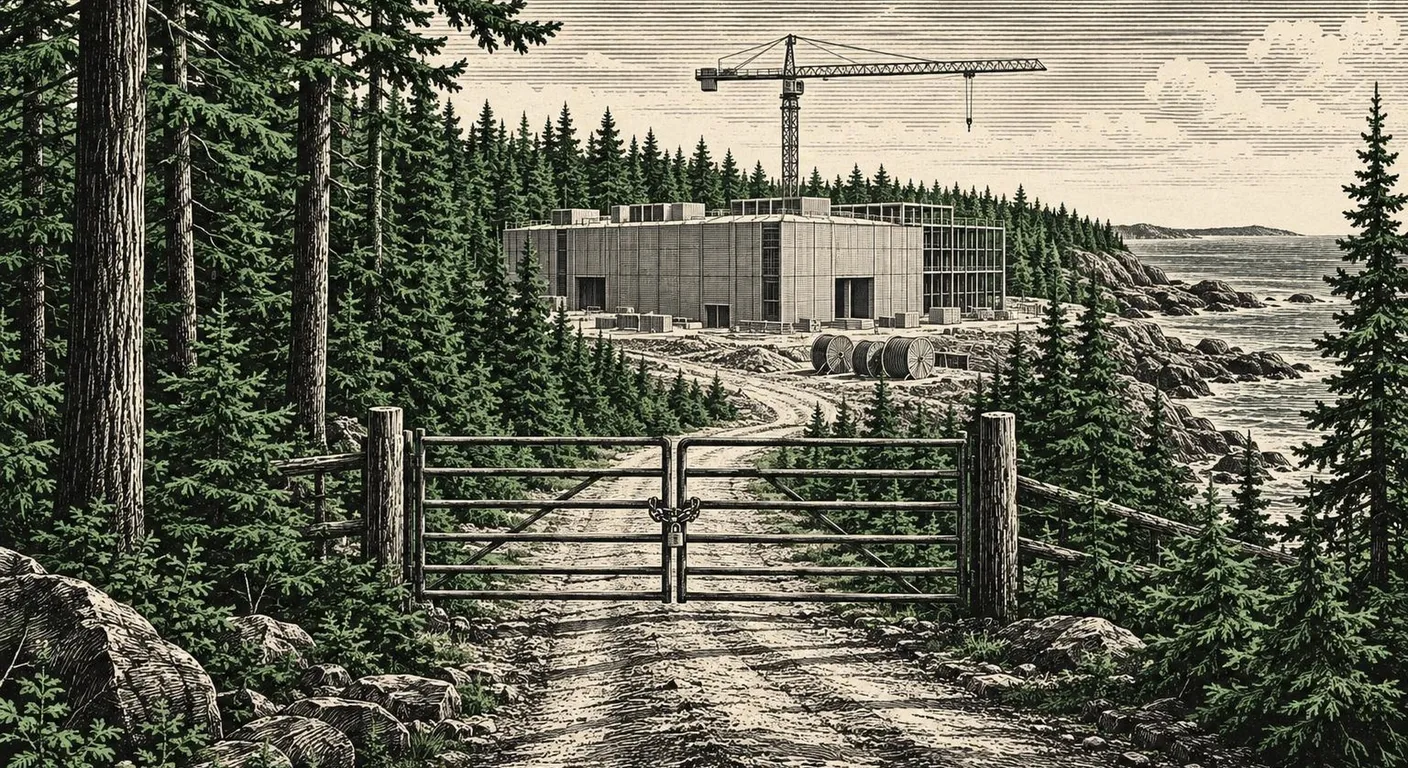
Maine's legislature just passed the first statewide data center moratorium in U.S. history. The governor hasn't signed it yet. And that might be the least important part of the story.
What actually passed
LD 307 bans new data centers larger than 20 megawatts until November 1, 2027. The House voted 82-62. The Senate followed 19-13. If Governor Janet Mills signs it, Maine becomes the first U.S. state with a statewide ban on data center construction.
She might not. Mills expressed reservations about a planned facility at a former paper mill in Jay, a town that badly needs jobs. She wanted an exemption carved out. The legislature refused. So now she has to choose between vetoing a bill her own caucus passed or killing a project she had publicly supported.
That's an uncomfortable position. But the bill's significance doesn't actually depend on her signature.
Why Maine snapped
From January 2025 to January 2026, Maine residents saw a 17.6% increase in residential electricity prices, the largest jump in the country. Data center developers were circling the state at the same time. The connection wasn't subtle.
A single large data center can consume more power than a small city. The facilities create relatively few jobs for what they take from a local grid. According to Pew Research Center, only one in four Americans believe data centers deliver meaningful local jobs. Half say they are more concerned than excited about AI's role in daily life.
When residents are paying the highest electricity rate increases in the country and watching developers bid on their grid capacity, the political math becomes simple. The opposition in Maine isn't primarily ideological. It's economic and personal.
The national pattern
Maine is not an isolated case. It's the one that cleared both chambers.
According to lobbying firm MultiState, more than 300 bills covering moratoriums, tax-incentive rollbacks, and ratepayer protections were filed across 30-plus states in the first six weeks of 2026 alone. Bills to temporarily halt construction have been introduced in at least a dozen states, per the National Conference of State Legislatures. The others stalled. Maine passed.
As Business Insider reported, citing Data Center Watch, community-based opposition blocked or stalled roughly $160 billion in projects last year. That figure is large enough to matter to any capital allocation decision in the sector.
The backlash has gotten physical in at least one case. In Indianapolis, a city actively courting data center investment, councilman Ron Gibson had 13 shots fired at his door, with a "No Data Centers" note left on the doorstep. The FBI is assisting. In Colorado Springs, a public meeting about a proposed facility called "Project Taurus" drew crowds so large that the room, with a capacity of roughly 100 people, filled twice over and hundreds were turned away.
This is not a niche regulatory debate. It is a spreading public revolt.
Where the money is moving
Capital responds to resistance. Construction is already shifting to states that want the projects.
Texas received 233 gigawatts of power requests as of December, nearly four times the prior year's volume. Ohio, Indiana, and Louisiana are competing aggressively for projects. AEP Ohio, facing grid saturation, forced data centers to cover 85% of their claimed capacity commitments, which shrank its interconnection waitlist by 57%, down to 13 gigawatts. Even the states that want the business are finding the numbers hard to absorb cleanly.
Georgia Power's plan to add 9.9 gigawatts of new capacity carries an estimated $50 to $60 billion cost to customers over the coming decades. That cost doesn't stay with the data centers. It gets distributed across every residential ratepayer on the grid.
The pledge that may not be enough
In March, Amazon, Google, Meta, and Microsoft signed a White House pledge committing that their data centers would not raise local electricity bills. The timing wasn't coincidental. The industry watched the legislative calendar and made a political gesture.
Whether that pledge holds up against the actual economics of grid expansion is a different question. Utility cost allocation is not a White House press release. The commitments are real, but the mechanism for enforcing them at the state level, where electricity rates are actually regulated, is not obvious.
Why it matters
Big Tech spent the last three years treating the AI infrastructure buildout as a logistics problem. Secure the land, permit the facility, connect to the grid, build the racks. Move fast. Maine is the clearest signal yet that the constraint is not engineering. It's political.
The industry's standard playbook, promise jobs, negotiate tax incentives, move fast before local opposition organizes, is running into communities where the cost-benefit math is visible on the monthly electricity bill. You cannot outrun that.
The question now is whether the Maine bill's likely fate, a governor's veto or a narrow signing, changes the trajectory. It probably doesn't matter either way. The 300-plus bills, the $160 billion in blocked projects, the overflowing public meetings: those are the signal. Maine is the one that broke through. The pattern was already forming.
If the industry can't solve the ratepayer problem in states that are actively trying to attract the investment, how long before the states that are already hostile make their moratoriums permanent?
Originally published as an Instagram carousel on @recul.ai.