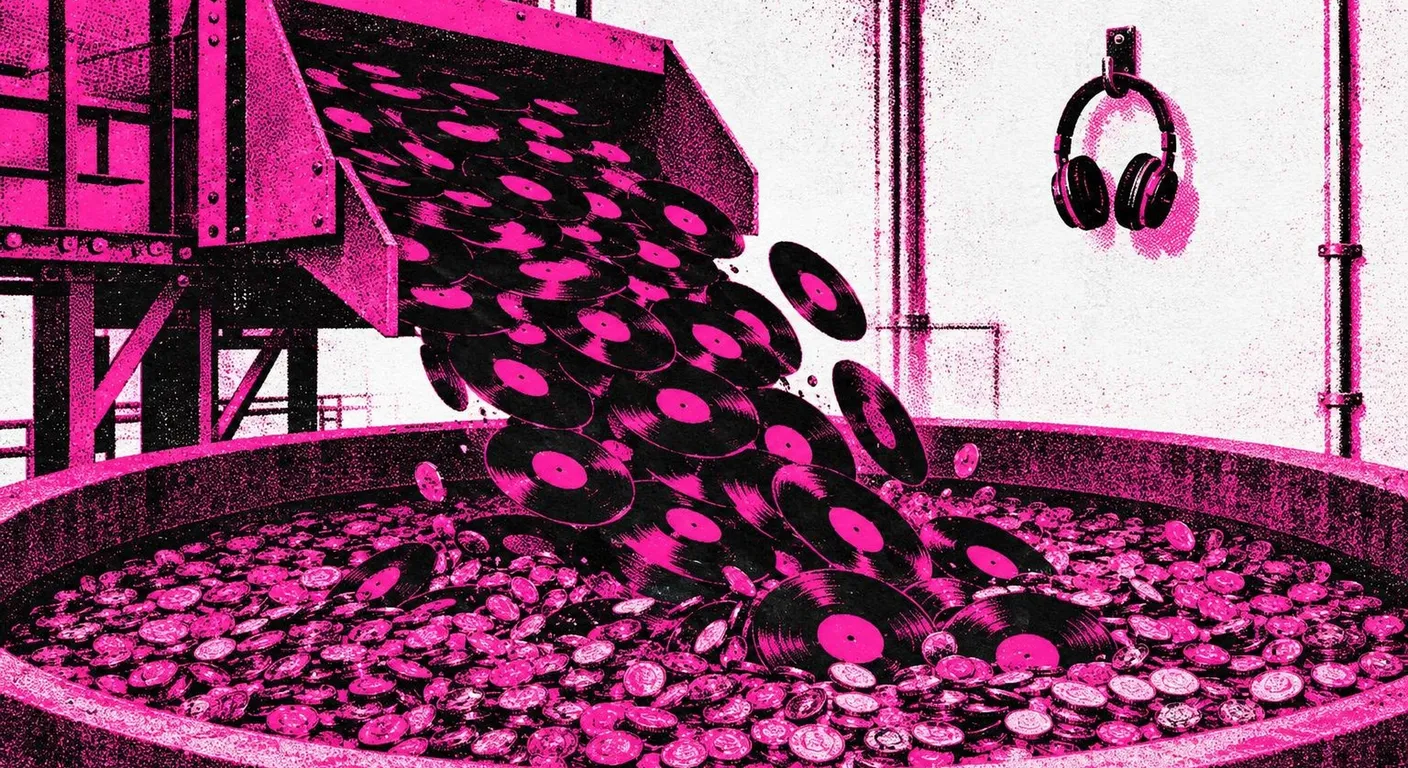
On April 20, 2026, Deezer announced that 44% of every new song uploaded to its platform is fully AI-generated. That is roughly 75,000 synthetic tracks per day, more than two million per month. Then the second sentence lands: almost none of it reaches human ears.
The growth curve has not bent
In January 2025, when Deezer first launched its AI-detection tool, the platform was receiving about 10,000 AI-generated tracks per day. By November 2025 that figure had hit 50,000. By January 2026, 60,000. By April 2026, 75,000. Roughly sevenfold in fifteen months, and the ceiling is nowhere in sight.
What makes the number strange is not that it is large. Suno and Udio have been generating publishable-quality music at streaming-service scale for two years. The strangeness is that while the upload curve has exploded, the listening curve has not. AI music accounts for just 1 to 3% of total streams on Deezer. Of those streams, 85% are flagged as fraudulent and demonetized.
So the flood is real, but only a sliver of it reaches listeners. Where is the rest going?
Bots listening to bots
The answer is the royalty pool. Streaming royalties are a fixed pot, divided by stream count. Every play is worth a fraction of a cent. If you can upload ten thousand tracks and farm ten thousand fake accounts to stream them on loop, you can drain a small but measurable piece of that pot before fraud detection catches up.
This is not speculation. It is what Deezer is telling us it sees. 85% of AI music streams are machine-generated: bots listening to bots uploaded by bots, a closed synthetic economy running inside a platform built for human artists.
The attack is economically rational because the defenders are slow and the attack surface is infinite. Generating a thousand songs costs almost nothing on Suno. Spinning up fake accounts costs almost nothing anywhere. Fraud detection has to find every bot. The bot only has to succeed once, and it can try again next week.
"Far from a marginal phenomenon"
Deezer CEO Alexis Lanternier said in the company's release that AI-generated music is now far from a marginal phenomenon. That is corporate language for: we have lost control of who is putting what on our platform.
Spotify, Apple Music, and YouTube Music have not published a comparable upload-share figure. Spotify has been loud about AI music in other ways: it deleted more than 75 million spam tracks in 2025, instituted a 1,000-stream royalty floor in 2024 targeting the exact fraud pattern Deezer is now flagging, and launched an AI-disclosure beta in April 2026. What it has not done is publish what share of its incoming uploads is AI. Deezer is the only one doing that, and the only one currently licensing its detection tool to other platforms, a program first sold to Sacem in January 2026. You do not build a business around a detection tool unless you have reason to think your competitors need one.
What the listeners actually think
In a Deezer/Ipsos survey published November 2025, 97% of respondents could not distinguish fully AI-generated music from human-made music in blind listening. 80% said AI tracks should be clearly labeled. 52% said AI songs should not appear alongside human music in the main charts.
Read those three numbers together. Listeners cannot tell AI from human. They want labels. They want AI songs kept out of the charts they treat as authoritative.
The policy debate everyone assumed was coming is not the real one. Listeners are not asking for a ban on AI music. They are asking for labels, and for honesty in the rankings. The industry has given them neither.
Why it matters
The easy read on this story is that AI music is flooding streaming services and displacing human artists. That framing is wrong. The flood exists, but only a thin fraction of it is reaching listeners. The real story is that streaming's royalty model was built for a scarcity economy, and generative audio has removed the scarcity.
One person with a Suno account and a bot farm can manufacture both supply and demand on the same day. The royalty pool, which was designed to split a fixed pot between humans making music for other humans, is now being split between humans and an expanding tide of synthetic uploads that exist solely to extract from the pot. Human artists are not losing listeners. They are losing a share of a fund that was never meant to pay machines.
Deezer's 44% is the first data point anyone has published. If that number holds across the industry, and if the growth curve continues, the question facing streaming is not whether AI belongs on these platforms. It is whether the economic model survives a supply curve that has grown roughly sevenfold in just over a year, with no ceiling visible.
The humans are still making music. The question is whether the pot they are sharing is being quietly emptied by code.
Would you pay extra for a streaming service that guaranteed every song in its library was made by a human?
Originally published as an Instagram carousel on @recul.ai.